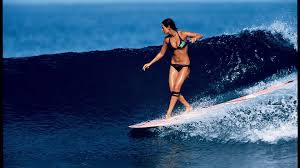
 One day I was out in the ocean, I was learning how to surf. The waves were fairly big and “crumbling”. As soon as I caught a wave I barely got to my feet before… Splash! I would unbalance myself and “dive tumble” into the waves. After my second frustrated attempt, I looked at my then partner and said, “What am I doing wrong, help me?” He looked at me compassionately and with his big heart said, “The waves are choppy, the conditions are bad, don’t worry, you’re doing well. Have one more go if you like and then we’ll go in.”
I looked around the ocean and sure enough, it was as I had suspected, dotted around the break line were people surfing. I could see that person over there standing up surfing perfectly, and that one over there didn’t seem to be having the belly flop problem I was having. I said out loud, though more to myself than anyone else, “It’s not the waves, it’s me. Those surfers know something I don’t know. I want to know what they know. What are they doing differently? Why can they stay up but I can’t?”
Feeling frustrated but determined I try again. The next wave comes along and I jump up on my board like I’ve been taught. Almost immediately I find myself diving off the board when it feels like the wave is disappearing beneath me, and I unbalance. “Aarg,” I bellow under the water.
Then it hits me. I realised what I’d been doing. Every time I stood up, my eyes shot D-O-W-N to see the wave crashing beneath me. Because I was thinking of this big wave crumbling and how choppy it was, naturally I followed my eyes path, and down I would go too. I followed my eyes, off the board into the very wave I was trying to ride.
It occurred to me that I should try out a little exercise I had just read about. There is a fabulous book called the Magicians Way, it’s a book about golf but it’s really a book about life and the over arching theme is focus. (As in: where you direct your attention.)
So next wave, same conditions, same board, but this time: I surfed all the way to the shore.
The small but significant (and only change) I had made was: my focus. Before I had hopped up onto the board, I had decided I would need to keep my eyes glued to the beach (where I wanted to head), instead of the crumbling waves (which I wanted to ride). So I ran my intention through my mind, “get up, look up, keep your eye on your target”.
Of course, as I got up onto the board, reflexively my eyes looked down, “No, no! Remember, look up!” I shouted to myself and I surfed all the way to the beach. I was absolutely thrilled, it was the best wave I have ever caught. I shrieked with glee, “It does work!” It really does work, your focus determines the results. Where you put your focus, that is where you are going to end up.
Last week, I had the pleasure of having a 15 minute interview with Christa Black Gifford after her recent trip out to Australia. Christa’s story and life journey are amazing sources of hope and inspiration and courage under fire. Christa has overcome an eating disorder, rape, drug addiction and losing a child. The primary message of her ministry is that love can heal your heart and a multitude of maladaptive coping mechanisms.
Christa is no stranger to having to feel and ride the pain wave. I work with many people who struggle with a challenging relationship with food. So I asked Christa to share her process with us.
What did she do when she was triggered to binge? (Which she has now overcome.) What did she do when she was in pain? How did she sit with it? No matter who you are or what you believe, pain is not completely avoidable.
Christa’s words and answers to my questions reminded me of the surfing story and that is why I shared it with you. She said. “Lisa, I never focus on the problem. Instead I focus on the recovery.”
Christa explained that instead of trying to focus on fixing the problem, she turned her focus and attention to what she would do afterwards. After a binge, instead of her previous automatic reaction which was shame and guilt and a long list of compensatory promises and plans to “regain control”, she would throw off the “cloak of shame”, and put her attention into that moment.
Christa explained that focusing on control, would almost certainly feed the “shame” cycle, because it’s not a matter of if we lose control, it’s a matter of when. She surrendered the idea of “ultimate control” and the feeling of shame and instead taught herself to receive love, recover from pain, visualise healing and pure unconditional love and acceptance flowing over her, in the moment when it would have normally been counter intuitive. She said she would remind herself “You are so loved right now.”
With that came healing, and when you feel loved and whole, the behavior changes. You stop needing the “fix”.
So often we are tempted to focus on the problem in order to resolve it… and often that just feeds or accentuates the problem.
(That is not to say: deny, or ignore or repress (pretend it doesn’t exist), that there is something that needs attention in your life.)
But it is to say, often there is an underlying need that is calling to be met, and if we are present and quiet enough, we can become aware of it and heal it. Following awareness we can turn our focus on getting the need met, recovery, healing and receiving love.
So a useful series of questions from a psychological stand point are:
“What is this feeling telling me?” Perhaps it is: I am feeling stressed and overwhelmed.
What is the underlying need? Maybe it’s: I need a break. (As opposed to: I need chocolate, which might be the “fix” or learned coping mechanism, not the actual “need”.)
If an answer doesn’t come straight away I have found a couple of Laurel Mellin’s (EBT) questions helpful:
What is the logical need? I need more energy. (Rather than: I need a coffee, or a stimulant.)
What is the deeper need? I need rest or I need support. (What I really need is a good dinner, a relaxing bath and an early night and snuggles with my partner.)
And what might be an unrealistic expectation. “I should be able to suck it up and push on.”
You can challenge unrealistic expectations: In actual fact, you need rest to function well, it’s ok to slow down and have a break sometimes.
Let’s unpack an example around eating behaviour.
Perhaps stress triggers an eating episode. The underlying need might be comfort. The deeper need might be connection. The unrealistic expectation might be: “I should have more self control.”
Many people with food addictions might be trying to soothe, comfort, distract, avoid, stimulate themselves in order to escape from an unpleasant feeling or emotion.
Becoming more aware of when you do this… and learning to understand what might drive your behaviour and what you are really yearning for, can help you focus on the solution instead of the problem.
Spread the Word to get this healthy message out! Like or share this page with your friends on your fave social media platform!


